
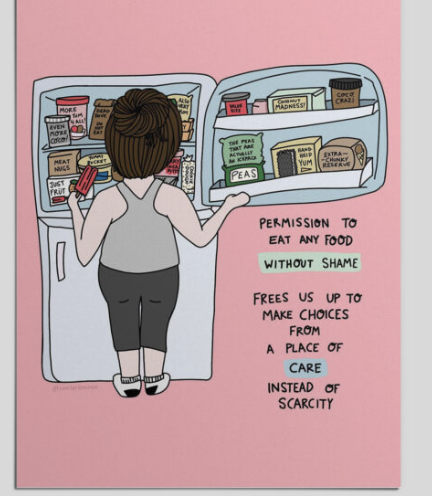
The other afternoon I opened my refrigerator and I just stared. Just me, in my kitchen, midweek, slightly hungry, slightly tired, trying to figure out what to eat for lunch.
Leftovers? Eggs? Toast with something? Sweet? Savory? Do I want something warm because it’s freezing in NYC again, or something crunchy like a big salad. Should I cook? Should I order? Is it “worth it” to make a whole thing just for me?
It was a small moment, but it reminded me how much mental energy food decisions can take up.
We talk about intuitive eating as if it’s simply “eat when you’re hungry and stop when you’re full.” But the truth is, for many people, the hardest part isn’t hunger or fullness. It’s the decision-making.
Between TikTok wellness trends, protein obsessions, glucose monitors, “what I eat in a day” reels, anti-seed-oil debates, and the never-ending pressure to optimize everything, food has become a performance. Even when we think we’ve stepped away from dieting, the noise lingers.
Research continues to show that decision fatigue is real! The more choices we make throughout the day, the harder it becomes to make grounded ones later. And when food has been moralized for years, every small choice can feel loaded.
As I stood there in my kitchen, I noticed something subtle: I wasn’t just asking, “what do I want?” I was asking, “what’s healthiest? What’s easiest? What should I want?”
That word, “should” is often the giveaway that diet culture is still in the room.
Intuitive eating is less about having perfect internal cues and more about practicing self-trust in tiny, ordinary moments.
Habit research tells us that behavior change doesn’t happen overnight. Studies still suggest that forming a new habit can take anywhere from a few weeks to many months, depending on the complexity of the behavior and the context of your life. Unlearning food rules, which are often decades old, is not a 30-day reset. It’s a gradual rewiring.
And here’s something I see clinically all the time: when people first step away from food rules, decision-making can feel harder before it feels easier. Without the rigid structure of a plan, there’s space. And space can feel destabilizing.
This is where the practice comes in. Instead of asking, What’s the “best” choice? try asking: “What sounds satisfying right now?” “What would feel grounding?” “What will keep me comfortably full for the next few hours?”
That day, I ended up making something simple and warm. Not because it was the “perfect” nutritional choice, but because it matched my energy and hunger. And once I stopped debating, the relief was immediate. The freedom wasn’t in the food itself. It was in the absence of the internal argument.
Some days intuitive eating feels seamless. Other days it feels clunky and loud. Both are part of the process. The goal isn’t to eliminate decision-making. it’s to soften it.
If you’re finding that food choices still feel exhausting or charged, you’re not failing. You’re likely unwiring years of conditioning. And you don’t have to do that alone. Feel free to reach out at rachel@livehealthynyc.com.